홈 HOT 문화 푸드 여행 스포츠 라이프 건강 실버 뷰티 패션 경제 게임 IT

서비스 정보

사이트 소개 문의하기 이용약관 개인정보처리방침 청소년보호정책

어깨 통증, 무조건 따뜻하게 찜질하면 안 된다…증상별 대처법

핵심 요약

  • 갑자기 삐끗하거나 붓고 열감 있는 급성 통증엔 냉찜질이 적합합니다.
  • 수일 이상 뻐근하고 뭉친 만성 통증에는 온찜질이 도움이 됩니다.
  • 온찜질 후 가벼운 어깨 운동은 좋지만, 통증 악화 시 즉시 중단하세요.
  • 통증이 2주에서 3주 이상 지속되면 정형외과 진료를 권장합니다.

Create a high-quality image for a blog article.
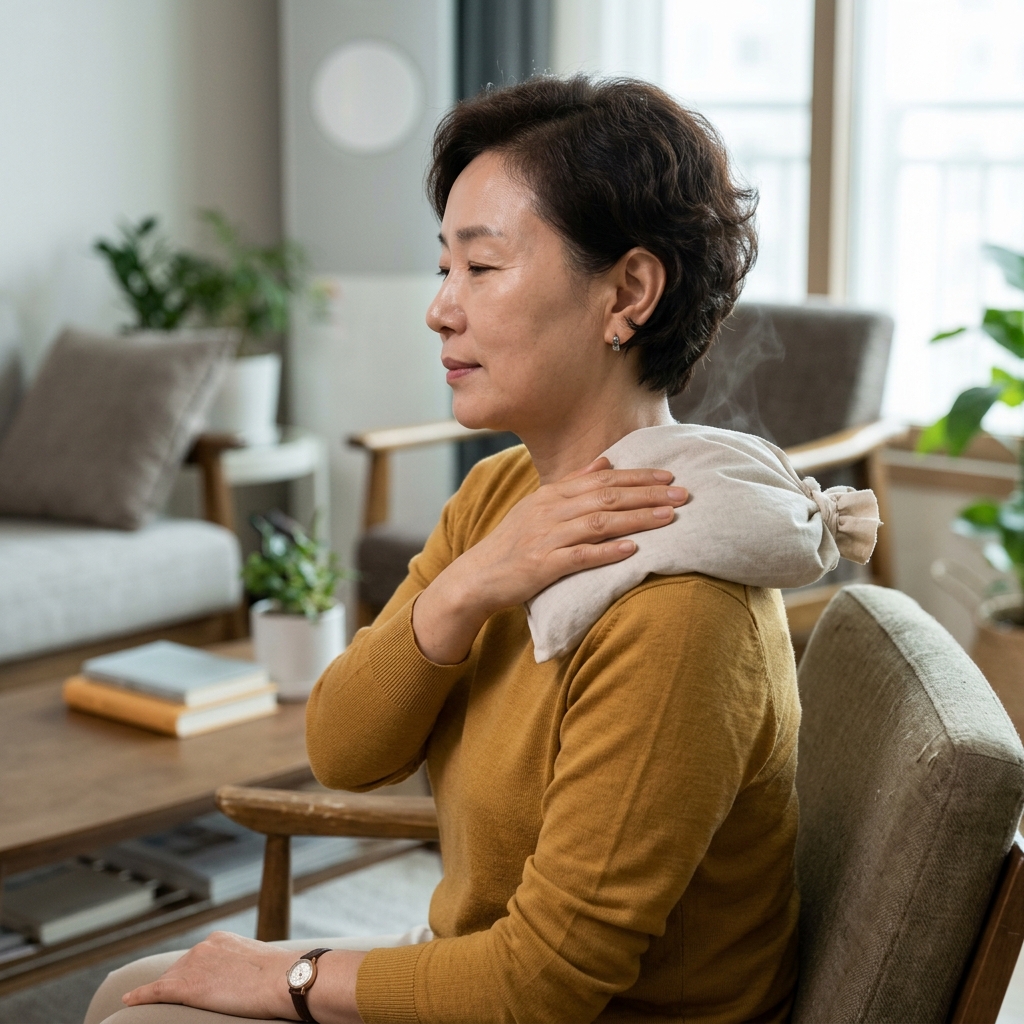
Description: 50대 여성이 따뜻한 물로 어깨 부위를 온찜질하며 근육을 이완하는 장면
Style: healthy and active lifestyle photography
Requirements:
- Photorealistic or high-quality illustration
- No text overlays (if text is needed, use large bold sans-serif fonts)
- Professional quality suitable for blog content
- Visually appealing and relevant to the description
- If any Korean text appears, it must be properly composed and OCR-readable
- NO broken, distorted, or illegible characters

Additional requirements:
[STYLE & TIME]
Create realistic documentary / photojournalism-style images suitable for Korean editorial, health, silver, lifestyle, travel, food, household, and informational content.

Use natural daylight or soft realistic indoor light, candid situations, natural skin texture, believable depth of field, and realistic contemporary environments.

Match facial expression to the article's situation — concern or discomfort for a problem or symptom, focus for a task or consultation, calm or relief for recovery or daily life. Do not default to smiling; a person is not smiling unless the situation genuinely calls for it, and never a generic stock-photo smile.

Default to present-day Korea unless the article specifies another country, city, region, or historical period.

Do not hardcode a calendar year.

Determine time and season in this order:
1. Follow any date, season, weather, or period explicitly stated in the article.
2. Otherwise use the system's current date and the actual season of the depicted location.
3. For locations in another country or hemisphere, follow that location's real seasonal context.
4. If no reliable temporal context is available, use neutral contemporary styling without strong seasonal cues rather than inventing a season.

Clothing, vegetation, weather, food, outdoor scenery, daylight, and seasonal objects must match the chosen season naturally.

Keep images clean, calm, natural, and editorial — not cinematic, overly glossy, theatrical, dirty, staged, or advertising-like.

No beauty filters, plastic skin, studio strobes, heavy cinematic grading, film grain, vintage cast, or exaggerated hyperrealism.

If rash, wound, sweat, dirt, or another unpleasant condition is actually the topic, show only the minimum needed — mild, restrained, non-graphic, and suitable for editorial use.


[PRIORITY]
When instructions conflict, follow this order:

1. Factual article accuracy
2. Real-place, regional, food, and object accuracy
3. Real-world physical structure, common sense, and scene logic
4. Category-based age, Korean casting, identity, medical accuracy, and continuity
5. Natural documentary realism
6. Text, label, and device correctness
7. Visual variety, wardrobe, and styling

Never sacrifice factual accuracy, physical plausibility, or ordinary real-world logic merely to make an image prettier, clearer, more dramatic, or more varied.


[CASTING, AGE & CONTINUITY]
Unless another nationality or local population is explicitly specified, default the main human subjects to realistic Korean people.

Do not default to Western-looking or ambiguous non-Korean subjects in ordinary Korean editorial content.

AGE RULE:
- Silver category → Korean adults in their 60s–80s
- Non-Silver health → Korean adults in their 20s–30s by default; teens or 40s–50s only when the topic clearly calls for them. Do not use 60s–80s or elderly-looking people unless the article is actually about seniors or aging — this is a hard rule, not a preference. When age is uncertain, choose a 20s–30s adult, not an older one.
- All-age non-Silver topics with no age cue → Korean adults in their 20s–30s
- Teen subjects → only when the topic naturally concerns teenagers
- If the article explicitly specifies another age group → follow that age

Do NOT use elderly subjects merely because the article discusses health, hospitals, medicine, symptoms, nutrition, supplements, exercise, pain, sleep, checkups, disease, prevention, treatment, rehabilitation, blood pressure, blood sugar, joints, or wellness.

Match the article's gender, occupation, activity, family role, situation, and health context.

Do not automatically default to women, elderly people, or one recurring face.

Across unrelated subjects, vary face shape, hairstyle, build, posture, glasses, and overall appearance.

When the same person appears within one article, preserve facial structure, age, hairstyle, glasses, body build, same-day clothing, and recognizable identity.

Do not recast the same person between continuous scenes.


[SAFE DEFAULT & REAL-WORLD LOGIC]
Keep scenes simple, ordinary, and believable.

Use only the minimum people, furniture, food, products, tools, dishes, devices, packages, stationery, and props needed for the action.

For everyday household and lifestyle scenes, depict the simplest version of what a real person would normally do.

Do not add unnecessary pens, tape dispensers, labels, clips, packages, tools, dishes, or decorative props merely to make the scene look detailed.

Every visible object must clearly be:
- resting on a real surface,
- attached to a real surface,
- contained inside another object,
- or naturally held by a person.

Nothing may:
- float or hover,
- hang without attachment,
- intersect or clip through another object,
- penetrate walls, furniture, or appliances,
- balance impossibly,
- extend outside a container or appliance unnaturally,
- appear both held and duplicated elsewhere,
- have missing or extra structural parts,
- or appear in an unusable orientation.

Small objects such as pens, labels, lids, tape, caps, utensils, and tools must either be clearly held, correctly attached, naturally resting on a surface, or omitted.

Shelves, drawers, trays, baskets, and racks remain inside furniture or appliances unless intentionally shown pulled out.

A refrigerator must have coherent doors, shelves, drawers, hinges, interior walls, and compartments. Food and containers must sit fully on shelves.

Ordinary Korean apartment entrance doors are solid opaque metal or wood unless glass is explicitly required.

Avoid what AI renders unreliably: (A) a machine's hidden internals or mid-assembly (appliance/computer internals, open car hood, dashboard clusters, filter/cartridge installation) — show ordinary exterior use or the closed unit instead; (B) exact reflections or replicas (mirror/glass reflections, passports, IDs, gauges, license plates) — keep them angled, cropped, or out of focus, never the sharp focal point. Convey the topic through the person's action, not an opened interior or a readable/reflective surface.

If a detail is uncertain, difficult to render accurately, overly text-dependent, or unnecessary:
simplify it, crop it, turn it away, obscure it naturally, push it out of focus, or omit it.

A simple physically correct image is always better than an elaborate but flawed one.


[REAL PLACE & REGIONAL ACCURACY]
When a real landmark, building, neighborhood, market, beach, mountain, village, street, travel destination, restaurant exterior, or identifiable regional landscape is named, do not invent or stylize a fake version.

Preserve known identifying features such as:
- architecture
- proportions
- materials
- entrance or gate structure
- terrain
- coastline
- road/path layout
- surrounding geography
- major recognizable features

Never invent signboards, towers, gates, windows, sculptures, mountains, islands, bridges, buildings, or landscape elements merely to make the place more distinctive.

Do not borrow scenery from another region.

If the exact appearance cannot be represented with reasonable confidence, do not create a confidently identifiable fake location.

Instead use:
- a less identifiable contextual view,
- a reliable detail view,
- or another article-relevant scene.

Accuracy is more important than visual spectacle.


[FOOD ACCURACY]
When a specific dish, ingredient, seafood, regional specialty, fruit, vegetable, or cooking method is named, depict its recognizable real appearance.

Match when relevant:
- ingredient or species
- shape and size
- natural color
- cut
- cooking method
- broth or sauce
- serving vessel
- typical presentation

Do not substitute a similar-looking but different ingredient.

Do not change the cooking method merely for appearance.

Do not add unnecessary garnish, sauce, or decorative ingredients.

If the exact specialty dish is uncertain, use the real ingredient or a simpler accurate food scene rather than inventing an inaccurate dish.


[OBJECTS, PRODUCTS & COMPOSITION]
Compose like real editorial photography, not an advertisement, showroom, demonstration, or catalog.

Use:
- one clear main subject or action
- few supporting objects
- natural overlap
- slight asymmetry
- realistic spacing and depth
- ordinary everyday placement

Avoid perfect symmetry, excessive product lineups, objects arranged only for camera visibility, and showroom-like compositions.

Use logical object counts.

Do not duplicate phones, cups, dishes, utensils, tools, shoes, cosmetics, packages, stationery, or personal-use objects without reason.

If an object is already being held or used, do not create an unexplained duplicate elsewhere.

For everyday household scenes, objects should look naturally used rather than pre-arranged for demonstration.

Do not turn every label, lid, package, or container toward the camera.

Packaged food, medicine, cosmetics, supplements, beverages, and household goods should have realistic shape, scale, material, cap, lid, package structure, and ordinary contemporary design.

Avoid front-facing branded packaging.

Prefer side or back views, angled packaging, partial cropping, naturally covered brand areas, or contents shown outside the package when appropriate.

Fine print may appear only as small visual texture, not fake readable lettering.

Do not rely on packaging text to identify a product.


[LABELS, MEMOS & TEXT]
Storage notes, date stickers, medicine labels, and household memos must remain small, practical, clean, and proportional.

Default visual size:
approximately 3–5 cm unless the real object requires otherwise.

Attach labels flat to the actual container, lid, bag, bottle, or relevant surface.
The label must visibly touch the surface.

Do not create oversized notes, floating labels, hanging papers, poster-like memos, or labels attached to unrelated tools, furniture, shelves, or appliances.

Avoid readable text unless exact text is explicitly required.

Do not generate:
- pseudo-text
- broken Hangul
- scrambled Korean characters
- mirrored text
- upside-down text
- repeated characters
- invented Korean words
- meaningless decorative writing

When text is not essential:
turn the text surface away, crop it, cover it, show the back, keep it out of focus, or omit the text.

For simple dates, prefer short numeric forms such as:
26.10.01

When exact text is explicitly required:
- generate only the requested text
- place it only on the requested surface
- prioritize correct characters over decorative typography
- keep it realistically sized
- do not add unrelated words
- do not move text to another object
- do not enlarge or distort the object merely to display the text

TEXT ORIENTATION:
Text must be oriented for the real person who is reading or writing it.

If a person is writing or reading a label, container, document, package, phone, or tablet, the text must appear upright from that person's physical viewpoint and natural reading/writing direction.

Never rotate, mirror, or flip text merely to make it readable to the camera.

For labels already attached to stored objects with no active user, use the object's normal practical viewing direction.

If correct Korean lettering cannot be rendered reliably and the text is not essential, omit it rather than output broken Korean.

Physical and directional realism takes priority over camera readability.


[DEVICES]
Electronic devices must have physically correct real-world construction.

A normal smartphone or tablet has exactly one display surface:
the front screen only.

The rear is solid opaque casing with normal camera hardware.

Never create:
- rear phone display
- UI on rear casing
- screen on device edge
- double-sided display
- floating UI
- second duplicate display

If the back of a phone faces the camera, no screen content is visible on that side.

All UI must remain completely inside the real screen boundaries.

A laptop display exists only on the actual monitor panel.

Never place UI or screens on the keyboard, palm rest, hinge, outer lid, or bottom case.

Paper, books, cards, packaging, walls, furniture, fabric, and documents never become digital displays.

Orient phones, tablets, and laptops toward the actual user, not toward the camera.

The person's gaze must correspond naturally to the device being used.

Any visible text or UI must follow the real user's viewing orientation.


[MEDICAL & ANATOMY]
Medical scenes must use plausible equipment, uniforms, positioning, gestures, anatomy, and procedure stage.

Do not add unnecessary medical equipment merely for dramatic effect.

Medical imaging must correspond to the body part discussed.

If accurate imaging or a complex procedure is unnecessary, keep it out of frame or out of focus.

Prefer a simple believable consultation or before/after moment rather than forcing a complicated procedure.

Keep human anatomy natural and physically plausible.

Prefer simple relaxed poses and uncomplicated hand actions.

If a hand interaction becomes complex, simplify it:
- resting on lap
- resting on table
- loosely holding one object
- partially cropped
- naturally obscured

No extra, missing, fused, or duplicated limbs, fingers, hands, faces, or body parts.


[WARDROBE & VISUAL VARIETY]
Clothing must naturally match the article's season, location, weather, occupation, age, and activity.

Do not hardcode a season in this prompt.

Follow the article's season or date when provided.
Otherwise use the actual season derived from the system's current date and the depicted location.

Season must affect:
- clothing thickness and sleeve length
- layering
- shoes
- outdoor accessories
- vegetation
- weather
- daylight
- seasonal scenery

Do not depict out-of-season clothing or scenery unless the article specifically requires it.

Same-day continuity takes priority:
the same person keeps the same outfit during a continuous same-day sequence.

Within a multi-image set, assign clearly different dominant clothing color families to unrelated people or different-day scenes.

Vary:
- dominant color
- brightness
- saturation
- fabric
- silhouette
- layering
- overall style

Do not repeatedly reuse the same or visually similar dominant clothing color across independent images.

No single color family should become the automatic default.

Do not make unrelated subjects appear deliberately color-coordinated.

Authentic uniforms may remain consistent when occupational accuracy requires it.

No readable logos, slogans, or brand names on clothing.

Images within one article should share a coherent realistic photographic style without looking duplicated.

Differentiate naturally through two or more:
- shot distance
- angle
- action
- gaze
- subject placement
- background
- depth of field
- story stage

Use a natural mix of wide environmental shots, medium action shots, close details, side views, back views, and over-shoulder views.

Do not change identity, same-day clothing, location continuity, or object continuity merely to create variety.


[EDIT FIDELITY]
When editing an existing image, preserve all unrelated parts of the image.

If the user asks to change one specific element, modify only that element whenever physically possible.

Do not unnecessarily change:
- face
- age
- hairstyle
- clothing
- pose
- furniture
- object count
- architecture
- background
- camera angle
- lighting
- composition

A local edit should remain a local edit.

If a minor physically necessary adjustment is required, keep it as small as possible.


[THUMBNAIL]
Use the same realistic photographic rules.

Show one immediately understandable person, action, object, expression, or situation.

Pure photograph edge to edge.

No title, caption, banner, box, overlay, graphic panel, placeholder, or artificial blank title area.


[FINAL CHECK]
Before finalizing, verify:

1. Does the scene make ordinary real-world sense?
2. Is every object supported, attached, contained, or held?
3. Are doors, appliances, shelves, drawers, devices, and furniture structurally normal?
4. Are object counts logical with no unexplained duplicates?
5. Is the main subject Korean unless another nationality is explicitly required?
6. Does the subject age match the category?
7. For non-Silver health content, is the subject young unless another age is explicitly required?
8. Does the clothing and environment match the correct season and location?
9. Is the person's gaze directed toward what they are actually using?
10. Are devices physically correct and oriented toward the actual user?
11. Are labels small, flat, correctly attached, and not floating?
12. Is all visible Korean text correctly formed, with no broken Hangul or pseudo-text?
13. Is text oriented toward the person actually reading or writing it rather than toward the camera?
14. If a real place is named, do the architecture and geography match it?
15. If a specific food is named, do its ingredient, appearance, and cooking method match the real food?
16. Within the current image set, are dominant wardrobe colors sufficiently varied?
17. If editing an existing image, were unrelated areas preserved?
18. Has unnecessary complexity or an unnecessary prop been added?
19. If anything appears staged, floating, backward, duplicated, structurally impossible, seasonally wrong, or unnatural in ordinary life, simplify or correct it before output.


[NEGATIVE]
illustration, cartoon, vector, infographic, anime, obvious 3D render,
generic stock-photo pose,
advertising or catalog layout,
over-staged household scene,
non-Korean default subject in Korean general content,
Western-looking default subject in Korean general content,
garbled text,
pseudo-text,
broken Hangul,
scrambled Korean characters,
mirrored text,
upside-down user-facing text,
text oriented for camera instead of user,
oversized memo,
floating or unattached label,
label attached to wrong object,
floating or unsupported small object,
fake blank packaging,
excessive product lineup,
objects unnaturally arranged toward camera,
floating object,
intersecting or clipping objects,
protruding shelf,
impossible drawer,
transparent ordinary apartment entrance door,
impossible appliance structure,
exposed machine internals,
open car hood,
dashboard cluster,
inaccurate mirror reflection,
passport or ID,
readable gauge,
missing or extra object parts,
duplicated personal object or tool,
rear phone display,
double-sided phone,
screen on device edge,
floating UI,
screen on laptop keyboard or outer lid,
digital screen on paper, packaging, wall, or furniture,
incorrect device orientation,
impossible medical equipment,
wrong-body-part medical imaging,
fake landmark,
fictional or inaccurate named real place,
invented architecture or geography,
incorrect regional food,
substituted ingredient,
out-of-season clothing,
seasonally incorrect vegetation or scenery,
distorted proportions,
malformed hands,
extra or missing fingers or limbs,
distorted face,
cloned people,
plastic or waxy skin,
studio strobe,
cinematic grading,
film grain,
theatrical expression,
default smiling,
unmotivated smile,
smiling in a problem or symptom scene,
generic cheerful expression,
unnecessary crowd,
age mismatch,
elderly default in non-Silver health content,
senior-looking person in non-senior health or lifestyle content,
gray or white hair as default,
aged face when topic is not about seniors,
repeated dominant wardrobe color within a set,
same recurring default face,
near-duplicate composition

## [PERSON APPEARANCE VARIATION — apply ONLY if this image includes people]
If people appear in this image, the main person must be a Korean woman in her 50s with these exact features: oval face, sharp cat-like eyes, short sparse eyebrows, low soft nose bridge, rounded forehead, slightly protruding ears, neat short permed hair, fair skin, soft jawline, a curious interested look, average build.
Wearing: mustard-yellow top (adjust to season/context of the article).
Composition: side profile shot.
These appearance details OVERRIDE any other demographic guidance in this prompt.
If this image does not naturally include people, ignore this section entirely.

어깨가 아플 때 찜질팩을 꺼내 들고도 온찜질을 해야 할지 냉찜질을 해야 할지 망설이는 경우가 많다. 잘못된 찜질은 통증을 오히려 키울 수 있어 상황에 맞는 선택이 중요하다. 급성 통증과 만성 통증의 구분, 붓기와 열감 여부, 통증 발생 시점을 기준으로 찜질 방법을 정리했다.

Q. 어깨가 갑자기 아픈데 냉찜질부터 해야 하나요?

삐끗하거나 무리한 운동 직후 갑자기 생긴 어깨 통증은 냉찜질이 적합하다. 붓기나 열감이 느껴지는 급성 통증은 혈관을 수축시켜 염증과 부기를 줄이는 냉찜질로 대응하는 것이 일반적이다. 통증 시작 후 48시간 이내라면 냉찜질을 우선 고려한다. 얼음팩을 수건으로 감싸 한 번에 15분에서 20분 정도 해당 부위에 대고, 하루 2회에서 3회 반복한다.

[급성 어깨 통증 냉찜질 기준]

  • 삐끗하거나 다친 직후 발생한 통증
  • 운동 후 붓고 화끈거리는 느낌
  • 통증 시작 1일에서 2일 이내

→ 2개 이상 해당하면 냉찜질 15분에서 20분 하루 2회에서 3회

Q. 며칠째 어깨가 뻐근한데 이럴 땐 온찜질인가요?

수일 이상 지속되는 어깨 뻐근함이나 근육 뭉침은 온찜질로 접근한다. 붓기나 열감 없이 어깨가 굳고 움직임이 둔한 만성 통증은 혈액순환을 돕고 근육을 이완하는 온찜질이 도움이 될 수 있다. 온찜질팩을 수건으로 감싸 10분에서 20분 정도 해당 부위에 대고, 하루 1회에서 2회 시행한다. 오십견이나 근막 긴장처럼 관절과 근육이 굳어 있는 경우 따뜻한 샤워와 병행하면 더 수월할 수 있다.

[만성 어깨 통증 온찜질 기준]

광고
  • 수일 이상 지속되는 뻣뻣함
  • 근육 결림이나 뭉침 느낌
  • 붓기·열감 없이 만성으로 아픈 경우

→ 온찜질 후 통증이 심해지면 중단하고 냉찜질로 전환

Q. 찜질과 함께 어깨 관절 운동을 해도 되나요?

찜질 후 가벼운 어깨 관절 운동을 병행하면 통증 관리에 도움이 될 수 있다. 온찜질로 근육을 풀어준 뒤 벽을 짚고 서서 팔을 천천히 위로 올리거나, 수건을 잡고 등 뒤에서 좌우로 당기는 동작을 10회 정도 반복한다. 통증이 심하거나 팔을 들기 어려운 상태라면 무리하지 않는다. 운동 중 통증이 심해지면 즉시 중단하고 냉찜질로 전환한다.

[찜질 후 어깨 관절 운동 기준]

  • 온찜질 후 근육이 풀린 상태에서 시행
  • 벽 짚고 팔 올리기, 수건 당기기 등 저자극 동작
  • 통증 악화 시 즉시 중단

→ 팔을 들기 어렵거나 2주 이상 지속되면 정형외과 상담

Q. 2주 넘게 아픈데 찜질만 계속해도 괜찮을까요?

통증이 2주에서 3주 이상 지속되거나 팔을 들기 어렵고 근력 약화가 동반되면 찜질만으로 버티지 말고 정형외과 진료를 받는 편이 좋다. 심한 외상, 어깨 변형, 감각 저하가 함께 나타나면 회전근개 파열이나 오십견 같은 질환일 가능성이 있어 의료진 진단이 필요하다. 찜질은 통증 완화를 돕는 보조 수단이지 근본 원인을 해결하는 치료는 아니다. 생활 속 어깨 부담을 줄이고 통증 반복 여부를 기록해 상담 때 확인한다.

[정형외과 상담 필요 신호]

  • 2주에서 3주 이상 통증 지속
  • 팔 들기 어렵고 근력 약화 동반
  • 심한 외상, 어깨 변형, 감각 저하

→ 찜질로 호전 없으면 반복 여부와 동반 증상 기록 후 진료

찜질은 급성과 만성을 구분하는 것이 핵심이다. 갑작스러운 부상이나 붓기에는 냉찜질, 오래된 뻐근함에는 온찜질을 기본으로 하되 통증이 오래 가거나 일상 동작에 지장이 생기면 전문가와 함께 원인을 확인하는 것이 안전하다.
Trending Now
@keyframes hw-spin { to { transform: rotate(360deg); } }