홈 HOT 문화 푸드 여행 스포츠 라이프 건강 실버 뷰티 패션 경제 게임 IT

서비스 정보

사이트 소개 문의하기 이용약관 개인정보처리방침 청소년보호정책

손으로 잡히면 피하지방, 안쪽은 내장지방…뱃살 케어 핵심 수칙은?

핵심 요약

  • 손으로 잡히는 피하지방과 달리 내장지방은 건강 위험이 큽니다.
  • 정제 탄수화물을 줄이고 단백질, 식이섬유 섭취를 늘리세요.
  • 정시 식사를 유지하고 야식과 음주를 끊는 것이 중요합니다.
  • 유산소와 근력 운동을 병행하여 전체 체지방을 줄이세요.

이런 분들이 읽으시면 좋습니다

  • 배가 나왔지만 손으로 잡히는 살이 많아 피하지방과 내장지방을 구분하고 싶은 분
  • 체중은 정상이지만 배만 유독 불룩하게 나와 내장지방을 걱정하는 분
  • 식습관과 생활 패턴 조정으로 복부 지방을 줄이고 싶은 분

Create a high-quality image for a blog article.
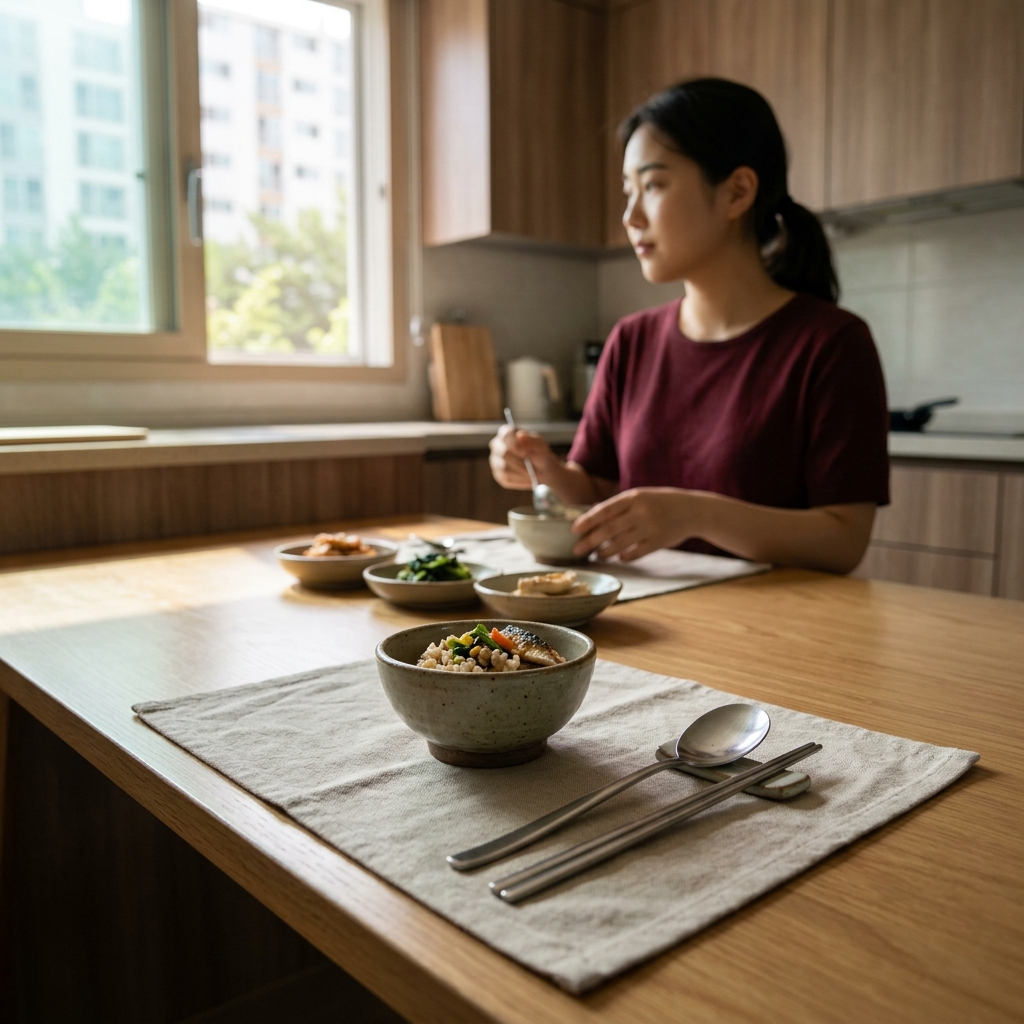
Description: 식탁 위에 놓인 작은 숟가락과 젓가락, 한 입 분량의 음식이 담긴 그릇, 평온한 식사 준비 장면
Style: healthy and active lifestyle photography
Requirements:
- Photorealistic or high-quality illustration
- No text overlays (if text is needed, use large bold sans-serif fonts)
- Professional quality suitable for blog content
- Visually appealing and relevant to the description
- If any Korean text appears, it must be properly composed and OCR-readable
- NO broken, distorted, or illegible characters

Additional requirements:
[STYLE] Realistic documentary / photojournalism. Natural daylight or soft indoor light, candid, authentic. Real Korean subjects, natural skin texture, shallow depth of field with natural bokeh. No beauty filter, studio strobes, or cinematic grading. Present-day Korea (2026): modern interiors, current clothing, up-to-date devices; no film grain or dated color cast. Keep it clean and comfortable to view — natural, not gritty. Show a condition the article is actually about (rash, wound, post-exercise sweat, skin problem) only when it is the topic, and then mild and non-graphic — never raw, gory, or repulsive. Otherwise keep skin healthy and clothing, bags, shoes clean and tidy. Exception: if the article is explicitly about the past or an earlier era, match that period.

[PRIORITY] On conflict, order: (1) article accuracy and logic; (2) subject age, identity, continuity, medical/location accuracy; (3) documentary realism; (4) text avoidance, object clarity, physical correctness; (5) differentiation across the set; (6) styling and color variety. Never sacrifice accuracy, identity continuity, or narrative logic for variety, color, or drama.

[SAFE DEFAULT] Keep scenes simple and clean: a plain setting, a calm subject or still life, uncluttered background, few objects. If any detail is uncertain or hard to render, simplify, crop, obscure, or omit it — never invent or force it; a clean believable image beats an ambitious flawed one. Actively avoid setups AI renders poorly: many identical labeled items facing the camera (store shelves, fridge cases, book spines, parked cars, signage walls); scenes that only work if text is read (receipts, prescriptions, screens, schedules, charts); precise tool-in-hand actions in close-up (injections, blood draws, stitching, cotton swab in the ear); and exact real-world specifics (named landmarks, brand logos, maps, currency). When a topic seems to need one of these, convey it indirectly — through a person's gesture and expression, a single item with text hidden, or the moment just before/after the precise action — keeping any such element minimal and out of focus. Prefer visually unmistakable action over scenes that need text to be understood.

[SET] One coherent image set for a single article (body images + one thumbnail), same style and topic, each visibly different. Thumbnail follows the same photo rules — never illustration. Treat each article as new casting: fresh, distinct people, not a default face or those used in other articles. Variety must never override identity, location, wardrobe, or logical continuity when the same person, place, or same-day event continues.

[CASTING] Derive the person from the article body, not a default: read who it is about (cases, examples, symptoms, scenarios) and cast their gender, age, situation. If the body implies a specific person (man in his 60s, mother of a toddler, office worker), depict that person. If unspecified, choose deliberately and cast men as often as women — never default to female across unrelated articles. Age must match the topic, including thumbnail and relevant background figures: pediatric → children + caregivers; adolescent → teens; young-adult → 20s; working-age → 30s–50s; senior → 60s–80s (no young adults/children as main focus). For general health/lifestyle not senior-targeted, default to 20s–30s (teens or 40s–50s when the topic calls for it); do not default to elderly for non-senior topics; reserve 60s–80s for senior or age-related topics. Never make an elderly subject look youthful or a senior topic look young. Within the required age, pick a distinct look, e.g.: lean, long narrow face, sharp cheekbones / stocky, broad jaw, thick brows / round soft face, full cheeks, slight stoop / tall angular, high forehead, swept-back hair / small slight, fine features, thick glasses / heavyset, wide face, cropped hair / fair complexion, low tied-back bun / thinning or balding, black-rimmed glasses / square face, strong jaw, deep-set eyes / compact muscular, thick neck, close-cropped hair. Vary hair (cropped, parted, tied back, permed, thinning, black, dark brown, dyed, salt-and-pepper, gray, white), skin tone, build, posture, glasses — matched to the age. When the same person recurs in one article, keep the same facial structure, age, hairstyle, hairline, glasses, build — do not recast between scenes. Back views, over-shoulder, hands-only, or people-free framing are valid when the topic allows.

[SUBJECT] People and real situations are usually the main subject — never a product as an advertising hero. When the article is about a place, food, object, ingredient, or phenomenon, a people-free scene (landscape, room, dish, ingredient, object in use) is fully valid; choose what the article calls for. Predominantly Korean (East Asian). The scene reads at a glance through the situation itself (problem, consultation, exam, treatment, recovery, comparison, decision, daily life). Candid gaze, natural body language, absorbed in the situation, not posing or staring at the camera. Match emotion to the stage — mild concern for a problem, thoughtful for a choice, focused in consultation, calm relief in recovery/daily life — never a default worried face, theatrical despair, or advertising smile. Use the fewest people needed; no background crowds unless the setting requires them.

[THUMBNAIL] Same realistic-photo rules — never illustration. Tighter crop on one face/expression, one clear action, or a single unmistakable situation, readable in under a second. Pure photograph edge to edge, with no generated title, caption, lettering, or graphic text anywhere — especially none across the top. Do not reserve a "title area" or add any box, banner, bar, overlay, placeholder, rectangle, or flat shape; empty space is just ordinary photographed background (wall, sky, furniture, soft bokeh). Do not fabricate blank panels to satisfy the no-text rule; get clean framing via angle, crop, depth of field, subject placement. Keep clothing prints, signs, and background lettering out of focus or out of frame. Thumbnail age and situation must match the topic.

[WARDROBE] Current season is summer (change this word as seasons change); dress for that season's real Korean weather (summer = light short sleeves, breathable fabrics, no heavy jackets; winter = knit, coats, padding; spring/autumn = light layers). If the body implies a specific season, setting, or activity (winter topic, exercise, sleep, bathing, hospital, outdoor work), let that decide instead. Ordinary age-appropriate Korean wear or authentic uniforms; no prints, slogans, logos, or brand tags. In a same-day continuous sequence, continuity wins: keep the person's clothing consistent unless the narrative requires a change. For color, actively lead with warm/earthy families — terracotta, mustard, olive, forest green, burgundy, warm brown, cream, rust, dusty rose, deep teal — varying hue, brightness, saturation, fabric, silhouette across the set. Cool blue, navy, beige, white, gray may appear occasionally but must not become automatic or dominate; do not dress unrelated people in the same/similar color, and never use medical-looking pale blue just because the topic is health. Keep colors realistic and age-appropriate. Exception: genuine uniforms (scrubs, caregiver wear, lab coats, school uniforms, workwear) may share colors and styles — do not force variation on them.

[LOCATION] Pick the setting from the article's context and vary it across topics — home, clinic, hospital, pharmacy, street, park, market, workplace, school, restaurant, community center, transit — not always a living room or hospital. Believable present-day Korean environments with fitting architecture, furniture, props; no generic AI studio rooms or showroom-perfect interiors; lived-in but clean enough for editorial. For a named real place, match its real architecture, terrain, layout, and features; never invent, stylize, or substitute a fictional version. If uncertain, use a plain non-identifiable setting rather than a confidently wrong one.

[SCENE & REALNESS] Landscapes, interiors, food, ingredients, objects may stand alone when the article is about them. Depict only real, plausible things as they normally look — real Korean places, dishes, ingredients, everyday objects with correct proportions, materials, and relationships. No fictional or fantastical substitutes: no imaginary landmarks, made-up food, impossible devices, surreal objects, fictional signage. If a specific real item is named, match its genuine look; if it can't be shown accurately, use a plain generic version, not a wrong or invented one.

[OBJECT & COMPOSITION] Compose like real editorial photography, not staged demos, ads, or AI catalog shots. Avoid perfect symmetry, default-centered subjects, and objects lined up toward the lens; allow natural overlap, partial cropping, foreground/background depth, slight asymmetry, ordinary placement. Keep one primary subject/action, few supporting elements, a believable background. Packaged items (milk/soy-milk cartons, medicine boxes, cosmetics, supplements, household goods) must look like real, ordinary Korean products with normal packaging design — realistic shape, cap, colors, simple graphic blocks — never blank white packaging and never covered in generated lettering; any fine print reads as soft, unfocused texture, not spelled-out words. Hide specifically the brand-name area (a hand holding the item, a slight side angle, an edge crop) while the product stays clearly identifiable by shape, color, and design — a viewer recognizes "that's a milk carton / a medicine box" at a glance with no readable brand name. Prefer hand-held or side-angle compositions that naturally hide the name, and keep any product minimal — one or two items, not a filled shelf or fridge. Distinguish similar items (milk vs soy milk) by color, design, and context (contents, vessel, the person's action), not readable labels; serving food or drink in bowls, cups, or plates is also fine.

[PEOPLE] Groups/family scenes mix ages, genders, faces, body types when appropriate; don't add people to fill the frame. Medical scenes use plausible settings, equipment, uniforms, positioning, gestures. Medical imaging (x-ray, scan, ultrasound, chart) must match the body part discussed — hand article → hand/wrist, knee article → knee, never an unrelated part. If uncertain or non-essential, keep imaging out of frame or out of focus. No unnecessary IV bags, injections, surgical gear, monitors, or dramatic props for medical effect.

[TEXT CONTROL] Avoid generating visible text; it should never be needed to understand the image. Do not fake, scramble, smear, or distort lettering — that produces garbled pseudo-text; remove text through composition instead (out of frame, turned away, cropped, blocked, or in soft background bokeh). When a text-bearing surface would exist (sign, screen, book, newspaper, menu, document, receipt, ID badge, clock, license plate, form), keep its printed face hidden this way. No prominent or readable brand names, logos, promotional wording, publication titles, employee/clinic names, room numbers, plates, medicine instructions, or forms; unavoidable incidental text stays tiny, distant, out of focus — never fake lettering. Packaging is the deliberate exception (see OBJECT & COMPOSITION): keep a realistic printed look and hide only the brand name, never a blank white package or sharp fake words. Devices (phone, laptop, tablet, TV, monitor) physically correct: a display only on the real screen side; rear, edges, casing have no screen, image, or glow; never a display on a non-screen surface; prefer user-side, screen dark/off, or angled away when content isn't essential.

[ANATOMY & OBJECT REALISM] Natural, physically plausible anatomy — correct limbs, joints, hands, fingers, facial structure, proportions. Simple relaxed poses and ordinary interactions; if a hand pose gets complex, simplify it (on a lap or table, loosely holding one object, partly out of frame, or obscured). No unnecessary multi-object hand interactions. Faces intact and natural (back, side, partial views allowed), never faceless, melted, or distorted; background people plausible too. Objects must also obey real-world scale, count, and structure: everyday items keep normal proportions (a cotton swab is short, a spoon spoon-sized), correct number (one swab in one hand — not two, not one in each hand), and complete structure (a refrigerator has doors, a mug one handle, a chair four legs). Show tools used the normal way a real person would; do not invent extra parts, missing parts, fused objects, impossible sizes, or duplicated tools. For a small precise action (cotton swab to the ear, tweezers, thermometer), keep one correctly sized tool, in one hand, in a simple natural pose, ideally at a slightly pulled-back angle rather than an extreme close-up.

[DIFFERENTIATION] Each image (including thumbnail) visibly distinct without breaking continuity. Differentiate via two or three of: shot distance, angle, action, pose, gaze, subject placement, background, depth of field, story stage, or wardrobe palette when a change is allowed. For independent or different-day images, wardrobe color aids differentiation — avoid the same dominant hue in consecutive independent images (not applied to same-day scenes or genuine uniforms). Use a range of shots: a wide environmental shot when setting matters, a medium action shot, a close detail or expression — not every image a waist-up medium portrait. At least one image may avoid centering a face (hands, back view, over-shoulder, object-in-use, environment). Mix front, side, back, three-quarter, over-shoulder views. Never change identity, clothing, or environment of a continuous same-day scene just for variety.

[NEGATIVE] illustration, clipart, cartoon, vector, flat design, infographic, 3D render, anime, drawing, painting, garbled or fake text, readable text, title/header lettering, text across thumbnail top, readable signs, readable brand name, spelled-out product name, garbled lettering on packaging, blank white or unlabeled packaging, store shelf full of products, fridge case full of cartons, rows of packaged products, wall of labeled packages, packed retail shelf, logos, publication titles, name badges, IDs, captions, watermarks, advertisement look, promotional poster, product hero shot, product-catalog framing, packages lined up toward camera, graphic title box, blank title panel, banner, overlay panel, solid color block, flat shape over photo, mismatched or wrong-body-part x-ray, anatomically inconsistent medical image, incorrect medical equipment, implausible medical pose, unnecessary dramatic medical props, screen on device back, display on non-screen surface, double-sided screen, fictional or inaccurate real place, fake landmark, wrong architecture, made-up food, impossible object, distorted proportions, oversized everyday object, wrongly scaled tool, elongated cotton swab, duplicate tool, two tools for a one-tool action, one tool in each hand, missing refrigerator door, missing or extra object parts, fused objects, structurally impossible object, malformed everyday item, posed stock-photo aesthetic, empty white studio, perfect symmetry, objects lined up toward camera, malformed anatomy, extra or missing limbs, malformed hands, extra fingers, three or six fingers, fused fingers, distorted or faceless face, severe facial asymmetry, crossed eyes, cloned or duplicated people, beauty filter, plastic or waxy skin, overly hyperreal, raw gory detail, bloody wound, graphic injury, oozing sore, repulsive close-up, filthy stained clothing, grimy shoes, grungy look, studio strobe, advertising smile, theatrical despair, posed expression, staring at camera, unnecessary crowd, wrong-era anachronism, dated color cast, film grain, vintage tone, out-of-season clothing, winter clothes in summer, elderly as default for non-senior topics, repeated dominant wardrobe color across unrelated images, everyone in the same or similar color, medical pale-blue as default civilian wear, recurring default face across articles, recast person between continuous scenes, non-Korean dominant cast when Korean required, age mismatch, youthful elderly, near-duplicate composition, repeated pose or angle, monotonous framing

## [PERSON APPEARANCE VARIATION — apply ONLY if this image includes people]
If people appear in this image, the main person must be a Korean woman in her early 20s with these exact features: wide face with soft full cheeks, downturned gentle eyes, thick bold eyebrows, small delicate nose, narrow forehead, ears visible, low ponytail, slightly tanned skin, defined facial contours, a curious interested look, petite build.
Wearing: burgundy blouse (adjust to season/context of the article).
Composition: candid shot from a diagonal angle.
These appearance details OVERRIDE any other demographic guidance in this prompt.
If this image does not naturally include people, ignore this section entirely.

손으로 잡히는 뱃살은 피부 바로 아래 쌓이는 피하지방이고, 배 안쪽 장기 사이에 끼어 잘 잡히지 않는 지방이 내장지방이다. 내장지방은 대사 질환과 염증 물질 분비에 직접 관련돼 건강 위험이 크다. 정제 탄수화물을 줄이고 정시 식사를 유지하며 야식과 음주를 끊는 생활 수칙이 뱃살 케어의 출발점이다.

피하지방과 내장지방, 촉감으로 구분 가능할까

피하지방은 피부 바로 아래층에 쌓여 손으로 잡으면 말랑하고 두툼하게 느껴진다. 주로 아랫배, 옆구리, 허벅지, 팔뚝에 분포한다. 반면 내장지방은 복강 안쪽 장기 주변에 쌓이고 배를 눌렀을 때 단단하고 팽팽하게 느껴지며 잘 잡히지 않는다.

배가 말랑하다고 내장지방이 없다고 단정할 수는 없다. 두 지방은 함께 증가할 수 있고, 외형만으로 내장지방량을 정확히 측정하기 어렵다. 허리둘레가 남성 90센티미터, 여성 85센티미터를 넘으면 내장지방 축적 가능성이 커지므로 체성분 검사나 의료기관 검사로 확인하는 편이 정확하다.

내장지방이 더 위험한 이유

내장지방은 대사적으로 활발해 염증 물질을 혈류로 내보낸다. 이 물질들이 인슐린 저항성을 높이고 혈당 조절을 어렵게 만들 수 있다. 간 주변에 쌓이면 지방간으로 이어지고, 심혈관 건강에도 부담을 줄 수 있다.

피하지방은 주로 외형상 문제와 관련되지만, 내장지방은 장기 기능과 직접 연결된다. 체중이 정상 범위여도 배만 볼록하게 나왔다면 내장지방 축적 신호로 볼 수 있다.

광고

정제 탄수화물 줄이고 단백질·식이섬유 늘리기

설탕, 흰 빵, 과자, 액상과당 음료는 혈당을 빠르게 올려 인슐린 분비를 자극하고 지방 축적을 촉진할 수 있다. 탄수화물은 현미, 통곡물, 잡곡밥처럼 식이섬유가 풍부한 형태로 바꾸면 혈당 상승 속도를 늦출 수 있다.

단백질은 포만감을 높이고 근육량 유지를 돕는다. 살코기, 생선, 달걀, 두부, 콩류를 끼니마다 포함하면 식사 후 허기를 줄일 수 있다. 채소는 식사 초반에 먼저 먹어 혈당 스파이크를 완화하는 방식으로 활용한다.

정시 식사와 야식 끊기

끼니를 거르고 한 번에 많이 먹으면 혈당이 급격히 오르고 남은 에너지가 지방으로 전환될 가능성이 커진다. 아침, 점심, 저녁을 일정한 시간에 먹고, 한 끼당 양을 적절히 조절하는 편이 혈당 흐름을 안정시킨다.

늦은 밤 야식은 간 기능 회복 시간을 방해하고 내장지방 축적에 영향을 줄 수 있다. 저녁 8시 이후에는 물이나 무가당 차로 마무리하고, 공복 시간을 최소 12시간 이상 유지하면 대사 부담을 줄일 수 있다.

음주 줄이고 유산소·근력 운동 병행

알코올은 간에서 우선적으로 분해되면서 다른 영양소의 대사를 밀어내고, 중성지방 합성을 늘려 복부 지방 축적을 촉진할 수 있다. 음주 빈도를 주 1회 이하로 줄이고, 고열량 안주 섭취를 함께 줄이면 효과가 더 분명해진다.

빠르게 걷기, 자전거, 수영 같은 유산소 운동을 주당 약 150분 목표로 꾸준히 실시하면 전체 지방 감소에 도움이 된다. 스쿼트, 런지 같은 전신 근력 운동을 주 2회에서 3회 병행하면 근육량을 유지하고 기초 대사량을 높일 수 있다. 복근 운동만으로 뱃살을 선택적으로 빼기는 어렵고, 식사 조절과 유산소·근력 운동을 함께 진행해야 전체 체지방이 줄어든다.

손으로 잡히는 살은 피하지방일 가능성이 크고, 단단하게 볼록한 배는 내장지방 신호로 볼 수 있다. 실제 관리는 두 유형 모두 정제 탄수화물을 줄이고 정시 식사를 유지하며 야식과 음주를 끊는 식단 조정과, 규칙적인 유산소·근력 운동을 함께 실천하는 것이 핵심이다.
Trending Now
@keyframes hw-spin { to { transform: rotate(360deg); } }